
Detroit’s recently launched MI Small Business Helper platform took years of persistent development to become a national model. Here’s what ecosystem builders can learn from their experience.
Detroit is a city that’s shown it can take a punch. It’s also shown it can build something that lands.
After years of building the foundation, pushing through setbacks, reinventing itself, and sheer Detroit persistence, the New Economy Initiative (NEI) launched MI Small Business Helper in October 2025, a platform that is becoming a national model for what an integrated entrepreneurial ecosystem can be. It’s what nearly two decades of unglamorous and persistent ecosystem work looks like once it finally comes together.
The Challenge and Opportunity
When NEI was founded in 2007, Detroit’s economy was still heavily tied to the manufacturing and auto industries, which were under pressure. The ripple effects were showing up across employment, income growth, business formation rates, capital access, and talent retention. Community stability was at stake.
“When the United States gets a cold, Detroit gets the flu,” NEI Executive Director Wafa Dinaro said bluntly. “And it’s because we’re so heavily manufacturing, so heavily auto. So NEI was really born out of the need to diversify our economy and become a little bit more resilient.”
In response to the growing crisis, 10 foundations pooled $100 million to jumpstart a new entrepreneurial economy from the ground up, with 75% of the pool coming from Kresge, Ford, and Kellogg. NEI emerged as a strategic grantmaking initiative housed at the Community Foundation for Southeast Michigan, tasked with building a diverse, resilient, connected economy that didn’t live or die by the assembly plant.
In the early phase, NEI provided direct investment into a range of organizations—accelerators, lenders, incubators, and technical assistance providers. The added funding allowed those organizations to serve more clients and extend their reach. NEI eventually opened a Business Support Network (BSN) office embedded at Invest Detroit, a separate organization with deep roots in the business community and direct connections to entrepreneurs on the ground. That office handled what became known as the “convenings,” the structured gatherings that brought business support organizations together around a table to share information, solve problems, and build relationships. These meetings also included capacity-building workshops and fostered rich personal relationships within the ecosystem. The culmination of all these efforts has been the launch of MI Small Business Helper.
The current organizational structure also took time to achieve, as NEI former Executive Director Pam Lewis noted in 2025 during an Entrepreneurship Funders Network webinar called “The (not yet complete) Story of NEI”: “The $100 million really showed up before the strategy… I think it goes to show that sometimes you have to take time to think about what the pillars of focus are going to be — and not be so stuck to it that they can’t change.”
But the most important work was getting the nonprofit business resource organizations (BSOs) to talk to each other rather than to compete. The philanthropic funding did not solve that problem.
What NEI did next wasn’t so much a formal pivot as a gradual shift in emphasis.
The Behind-the-Scenes Relationship Work
Ecosystem builders who want to replicate a tool like MI Small Business Helper can’t overlook the years of consistent convenings that made the platform possible. NEI has never missed a monthly engagement with its network of grantees and partners, which started as quarterly in-person convenings under program officer Don Jones. These assemblies became bi-weekly Zoom calls during COVID, and they continue to this day. These ongoing convenings built the trust that makes everything else possible. The NEI Worktable, as the convenings became known, now draws 90–95 people per session, including dozens of organizations NEI does not even fund.
From the get-go, these convenings were more than just check-in calls. They became a genuine safe space where BSOs could talk through real problems and discover ways to solve them. Acknowledging the protected environment, Wafa said: “We don’t have funders in the room. It’s just the business support organizations, and we talk about real issues. We problem solve, we collaborate, we innovate. It is not just ‘let’s identify the problems;’ it’s let’s find a solution and then let’s fund it.”
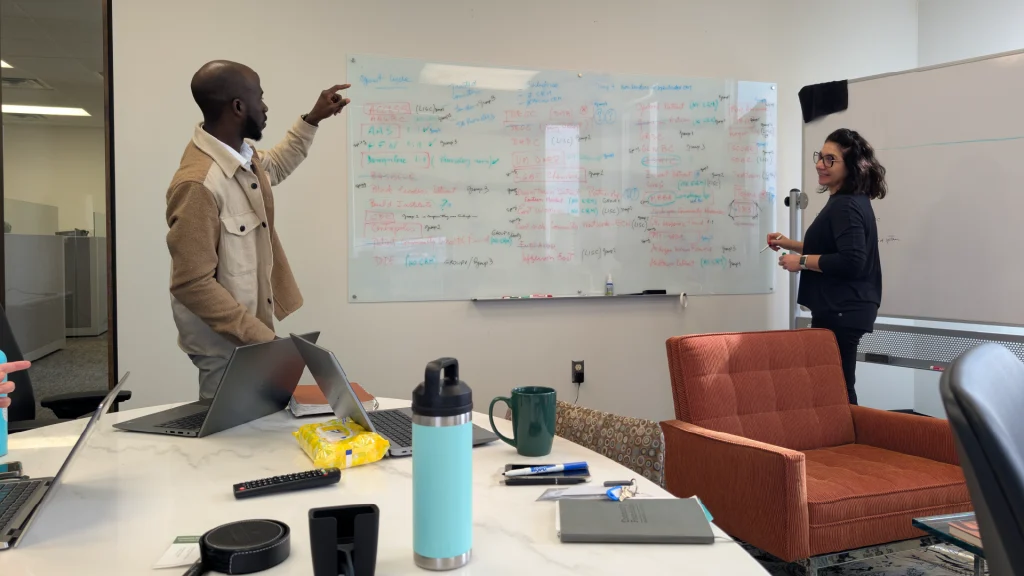
The committees that formed produced practical solutions. Lily Hamburger, former director of NEI’s Business Support Network Office, has experienced Detroit’s ecosystem development from multiple vantage points over the years. She describes an example of something a committee produced that lived beyond that committee: “In the Access to Capital Group, pre-pandemic, they produced a guide to accessing capital for Detroit small businesses [called] the Capital Readiness Checklist.” She noted that it’s still on the NEI website and also on MI Small Business Helper alongside several other co-created resources.
By keeping grantmaking and ecosystem-building separate, BSOs could be genuinely candid in the Worktable because they weren’t performing for funders. Lily said: “It doesn’t feel top-down. It feels very grassroots. It feels like a place where you can get advice, pick people’s brain, find collaborators for what you’re working on. The art of it is helping people play nicely in the sandbox together; that culture of cooperation versus competition that Don Jones cultivated. That takes constant nurturing.”
Hard Lessons
As much as the convenings led to progress in relationship-building and solving practical issues within the ecosystem, NEI did not get things right immediately. It shares that part of its story openly.
The shift from building simply to “build an ecosystem” to building with those who are part of the ecosystem is what finally began to steer NEI toward developing a useful and lasting platform. Roxana Martinelli, the NEI program manager who led the MI Small Business Helper implementation, described how that realization transformed the approach: “We were very intentional about how to engage with these resource partners, and to make sure that they knew that this was a product for them—and in part, co-designed with them. When we were discussing and validating the taxonomy, it was not something we did behind closed doors. We engaged them in focus groups; we took advantage of regular meetings that we had with them. This is what we have; this is what we think. What do you think?”
Perhaps the most consequential insight was recognizing that the entrepreneur had been left out of the equation almost entirely, leading to frustration for entrepreneurs. The consequence of that oversight showed up most clearly at the point of entry. Entrepreneurs experienced the ecosystem as a series of disconnected, hit-or-miss interactions rather than as a coordinated network. If the first organization they encountered couldn’t direct them effectively, the burden shifted back to the entrepreneur. Addressing the situation meant bringing entrepreneurs into the process in a way that influenced design decisions.
Fred Paul, NEI’s associate director who oversees business support network activities and guides partner engagement and convenings, said they began outreach to entrepreneurs by showing up at community fairs and conventions, encouraging the business support organizations to be advocates, and developing marketing collateral.
The SourceLink Advantage
SourceLink’s relationship with NEI began in 2018 with a collaborative ecosystem landscape analysis to help NEI figure out where they needed to go next. The exercise mapped the region’s strengths, identified its gaps, and offered a set of recommendations that became a blueprint for the organization over the next eight years. When NEI was ready to commit to a technology platform, they came back to SourceLink to build it, recognizing that, as their partner, SourceLink would bring a human-centered approach rather than just a tech play.
Following SourceLink's ethos of uplifting locally created work first, the team sought to incorporate and include as many preexisting assets as possible and then add new needed features and functionality. The result is MI Small Business Helper, a custom-built platform with a smart resource navigator that delivers tailored recommendations based on a business owner’s specific situation, stage, and industry. Every resource is vetted. There are no paid listings or for-profit businesses. Collaboratively developed business guides, including the Capital Readiness Checklist, are now housed in one place. Last, a robust shared events system that highlights all the wonderful business networking and learning events for businesses across Southeast Michigan.
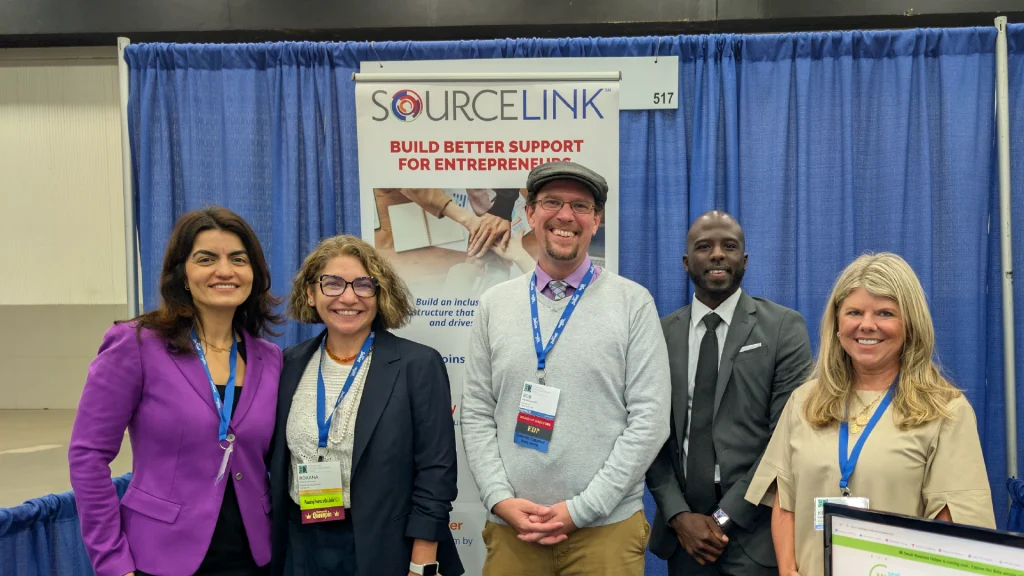
A significant feature is Circle, a built-in collaboration hub for the business resource providers that replaced many scattered Slack channels, Teams threads, and Dropbox folders that had housed the ecosystem’s institutional knowledge across dozens of different organizations.
“We had all of these different work groups,” Wafa said, “and every single work group was storing documents and chatting in a different kind of way. Now we have one singular place for all the ecosystem to use. Regardless of the platforms you’re using in your office, this is where everything for the ecosystem is going to live.”
The NEI team presented SourceLink with a rough visual concept that was basically a collection of ideas drawn from different SourceLink affiliate sites around the country, a e, the SourceLink and NEI teams built a custom platform together. Roxana described the complexity of coordinating what was, at the time, multiple organizations working in tandem:
“There were three people leading this project—one leading the relationship with the vendor, another leading the relationship with the ecosystem and resource partners, and another leading the team internally.… The complexity was to coordinate all these different entities, to make sure that they all had a common ground, but also how to translate what almost 100 resource partners were offering into something that was seen as a system, seen as a consolidated hub of resources.”
For its part, SourceLink ensured it understood what NEI considered success to be at the end of the first year, end of the third year, and other critical points. The team knew it had to start with the end in mind; otherwise, they wouldn’t know if they could be proud of the outcome.
The team also extended the standard onboarding timeline significantly, at least a month longer than usual, to allow for something Roxana called “peer validation”: Resource partners reviewed each other’s profiles before the platform went public, so that what entrepreneurs would see was accurate, complete, and trusted by the organizations themselves. A private launch event followed, so partners could see themselves on the platform before it went live to the world.
NEI also took a significant step that showed just how serious their effort was. They pulled key staff under one roof instead of continuing to function with some team members housed at the Community Foundation and others at Invest Detroit’s Small Business Network Office. The consolidation brought the ecosystem-facing and platform-facing work into a single, coordinated team. The result was less confusion for entrepreneurs, stronger internal alignment, and a shared institutional identity that hadn’t fully existed before.
Bringing the parties under one roof, “was a game changer,” noted Fred, sending the collaboration and trust levels soaring.
A National Model for Data Sharing
“We started collecting data early,” said Pam, “but what we realized is that just counting jobs or counting businesses didn’t tell us if the system was working… we needed to understand whether people were actually moving through the network.”
That insight led to the need for a more nuanced application of data. Instead of focusing solely on individual organizational performance, NEI began examining how entrepreneurs advanced through the ecosystem. Where did they enter? Where did they stall? Where were services duplicated or missing entirely? This shift revealed patterns that were not visible at the program level. It showed where coordination was breaking down and where relationships needed to be strengthened. It also highlighted opportunities to improve referrals by matching entrepreneurs with organizations better suited to their needs.
To bolster their data-sharing efforts, NEI is implementing SourceLink Enterprise, a CRM for ecosystem builders. It has been deployed in several other markets across the country. Not all of those stories have happy endings, because getting an ecosystem to share data, let go of territorial instincts, and trust that sharing client information serves the entrepreneur rather than a competitor’s pipeline, is extraordinarily hard.
NEI, however, is positioned to lead the country in demonstrating the value of data sharing across a network.
Why?
Because NEI spent more than 15 years building the trust that makes data sharing possible. As Lily put it (crediting author Adrienne Marie Brown): Ecosystems can only “move at the speed of trust.”
The business support organizations in the Detroit network know each other. They’ve worked on committees together, and they’ve been at the Worktable long enough and consistently enough to know that shared client data exists to help an entrepreneur get a better referral rather than be used against them.
SourceLink Enterprise helps the entrepreneur because it creates a shared CRM infrastructure where partner organizations can track a client’s journey across the ecosystem. Importantly, it has privacy controls and confidentiality built in.
Roxana candidly admits there is still some resistance and notes that it’s expected:
“It would not be honest to say that everyone is like, yes, let’s collaborate. Why am I going to be sharing this information? Maybe she’s going to get some of my clients. We are doing something kind of similar. I think that is there. But there is also a reality they all agree with: If you center the entrepreneur in your decisions, you will try to make their lives as easy as you can. This system would help make better referrals and avoid business owners having to fill out the same information over and over again.”
NEI’s strategy for getting everyone ion board is to start with the organizations that don’t already have a CRM system and use those early adopters to build a case for the rest.
“We want to onboard first those organizations that do not have a CRM system, or have a light version of one,” said Roxana, “and for them it will be a win-win situation: They don’t have to invest in a CRM system, they can use this one, and meanwhile they can also see what the benefits are. And once we can show that, we can use that as a supported case for other organizations to join, either integrating their existing systems or adopting the CRM.”
The goal is something ecosystem builders have talked about for a long time but rarely achieved: understanding which combination of services produces the best outcomes for which types of entrepreneurs. Lily described where that capability is ultimately heading: “It’s moving towards allowing us to say, okay, this suite of resources works best for this type of entrepreneur, or we’re seeing more success from this organization for that type of entrepreneur. Just getting a little beyond how many people do we serve.”
Fred uses a medical service provider analogy to drive home the point: A primary physician may see a patient first but then send that patient to a specialist, if necessary, where they can be better served. The goal is not simply to serve more entrepreneurs, he says, but to route them more effectively and ensure that each interaction moves them closer to what they need rather than repeating the same steps.
Eight Lessons for Other Entrepreneurship Ecosystems
Ecosystem builders around the country ask the same questions constantly: How do we develop a CRM? A navigator? A portal? The best question to ask is: Does the network itself exist yet? Technology isn’t the hard part; building trusting relationships and collaboration isbecause they are enduring and impactful.
NEI’s story teaches several lessons. Among them:
- Put people and relationships before tools. The trust has to come before the technology. Get the people in the room consistently and focus on building a culture before the platform.
- Consistency builds trust. NEI hasn’t missed a monthly engagement in over 15 years. That kind of consistency transforms a convening into a community.
- Own what you build. you hand a platform to a partner and walk away, you’ve created a situation where the ecosystem is . NEI owns, staffs, and funds MI Small Business Helper and has a dedicated team member who’s responsible for keeping the information current and approved.
- Put the entrepreneur at the center. When systems are designed around providers instead of entrepreneurs, they end up mirroring things like program silos, funding buckets, and internal priorities. But that’s not how entrepreneurs work. So, the real test for every design choice, any data-sharing discussion, any new feature is to consider whether it makes things better for the business owner. The community lost sight of this in earlier platform attempts. For NEI, getting it right meant going back to asking that question relentlessly.
- Manage scope. Roxana recalled early conversations where the platform was expected to connect to commercial banking, generate entrepreneur profiles, and solve every problem at once. Those considerations weren’t realistic. If you make your scope as clear as possible, you’ll get stronger results.
- Use pushback as a learning tool. Although pushback is inevitable, how you respond is not. Be strategic and show you are listening. That’s how you create champions of even the biggest naysayers.
- Technology is an enabler, not a solution in itself. As RoxanaRoxana noted: “It doesn’t matter what type of technology you use if you don’t have a solid dynamic with your partners and if you don’t understand the issues that need to be addressed.” The system has to be created before, or at least parallel to, the platform.
- Be realistic about funding. As Pam reminds: “To think that a leader of an ecosystem project can go and rally foundations to do this level of fundraising is misguided. You have to have funder champions. When they talk to their peers, that’s when they’ll listen.”
The (Not-Yet-Complete) Story Keeps Getting Better
NEI’s three- to five-year vision is not just Southeast Michigan, but a statewide platform for all. Conversations are already underway with potential partners in Kalamazoo, Grand Rapids, and other areas of the state. Entrepreneurs themselves don’t confine their businesses to a single city, and a platform that reflects the full regional landscape serves them far better than one that stops at a county line.
Ecosystem building work is never finished because entrepreneurial communities are always changing. Funders cycle in and out. Staff move between organizations. The economy throws curveballs. What makes NEI different isn’t that they’ve avoided disruption. Rather, they’ve built something durable enough to evolve and respond with it.
As Wafa reminded: “None of this work could be done without the relationships. And the relationships and the trust are at the core of everything that we do.”
Detroit persevered and did the hard relationship work that ecosystem building demands. And now, with MI Small Business Helper live and SourceLink Enterprise rolling out across one of the most collaborative entrepreneurship networks in the country, Southeast Michigan is positioned to lead the rest of the nation in what this work looks like when done right.
The New Economy Initiative recently released their 10 year retrospective. Be sure to check out the entire report.