
Spend enough time around entrepreneurship, and you’ll eventually see this familiar graphic:
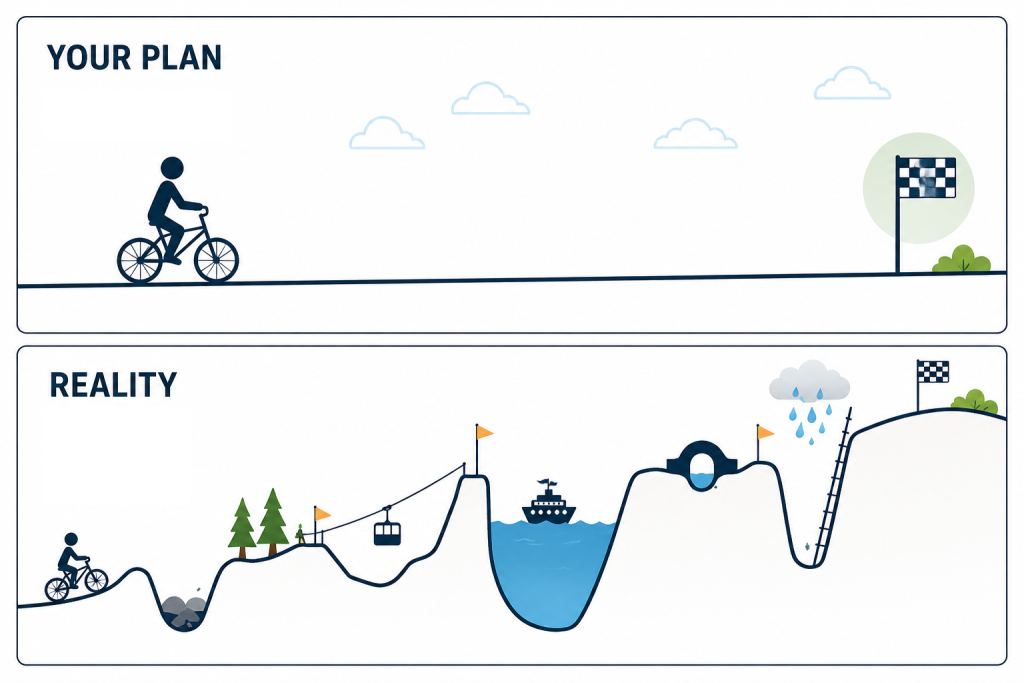
It is a simple illustration that paints a realistic picture of the entrepreneurial journey that is full of twists, turns, ups, downs, false starts, restarts, exhilarating climbs, and frustrating setbacks.
Back in my economic development days, I would have said that this was a pretty accurate picture of the entrepreneurial journey. For decades, economic developers and ecosystem builders have done important work designing systems of supports, resources, and programs around entrepreneurs along this path of starting, growing, and scaling businesses in our community.
We build incubators, accelerators, technical support initiatives, mentorship programs, funding pathways, innovation hubs; the list goes on. All important components of a healthy ecosystem. All important work that matters.
A Part of the Journey Often Overlooked or Misunderstood
What we’ve been learning through the work we’ve been doing at Mashup Lab over the past 10 years with thousands of entrepreneurs in over 700 communities across the US and Canada is this:
There is a part of this picture that is often overlooked and misunderstood. A part of the journey that is typically missing in the design of entrepreneurial ecosystems altogether.
This part:
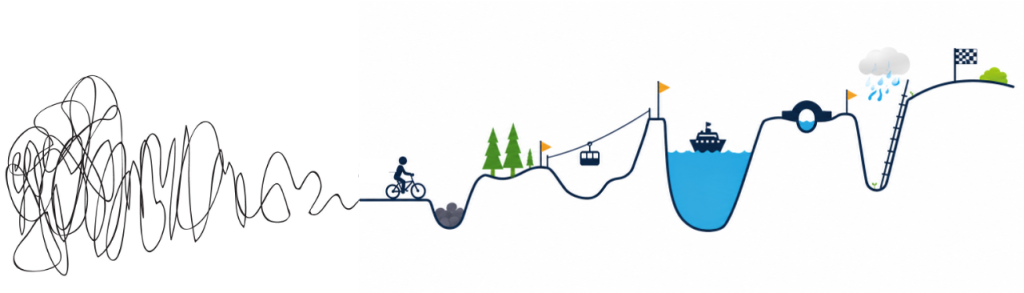
The messy, unpredictable, ‘all over the place’ part of the entrepreneurial journey that happens long before someone writes a business plan, creates a prototype, seeks technical assistance, or shows up in our entrepreneurial ecosystem. It’s the phase where people are circling possibilities, trying to connect the dots, uncertain about the path forward, and quietly wondering to themselves, “Could I actually do this?”
We call this the Activation phase of the entrepreneurial journey.
It is easy to understand why this Activation phase is often overlooked when designing our entrepreneurial ecosystems. It is messy. It is informal. Progress and impact are difficult to measure. Additionally, many of the people in the Activation phase have not yet identified themselves in our ecosystem.
Finding them requires a different approach and a different ‘playbook’.
What we’re learning about the untapped entrepreneurial potential ‘sitting on the sidelines’ in that messy part of the entrepreneurial journey, and why they are not plugging in to the entrepreneurial ecosystem that surrounds them, represents one of the biggest opportunities for Economic Developers and Ecosystem Builders … but it also presents some unique challenges.
The Untapped Potential in Our Communities
We are learning something that has fundamentally changed how we think about entrepreneurial ecosystem design:
There is a massive pool of untapped entrepreneurial potential sitting on the sidelines, not engaging with the existing entrepreneurial ecosystem around them.
Over the past 10-years, 81.4% of the 2000+ entrepreneurs we’ve put through the Mashup Lab Dream Business program (i.e. our virtual business activator / incubator) have never signed up for business or entrepreneurship program ever before, despite having access to literally dozens of other programs and supports, some of which available to them right in their own backyard.
They are not showing up to training programs.
They don’t access technical support services.
Not applying for incubators.
Not signing up for pitch events.
Anecdotally, we’re discovering that for every 1 entrepreneur who IS engaging with the local entrepreneurial ecosystem, there are often 7 more, “sitting on the sidelines” with great ideas for potentially viable business, invisible to the very systems designed to support them.
These are not ‘hypothetical entrepreneurs. These are employees, parents, hobbyists, tradespeople, professionals, students; people who have ideas, notice opportunities, and quietly wonder what it would look like to act on them. But they are not engaging with the ecosystem of support, resources, and programs that surround them.
From an entrepreneurial ecosystem building perspective, that’s not just a small gap in the entrepreneurial stack that is missing. This represents the majority of our entrepreneurial potential sitting outside the frame. It’s a design flaw that shapes where our focus, attention, and resources flow.
These Are Not Just New Entrepreneurs
We become very good at understanding who is inside the system, but our understanding of who is outside of it, and perhaps more importantly, why, is less clear.
When the conversation turns to talking about the kinds of entrepreneurs in this Activation phase, we often hear things like ‘they’re just tire-kickers, not really serious about starting a business’’, ‘they’re just running ‘cute’ hobby businesses, not legitimate companies’, or ‘they’re ‘wantrepreneurs’, not REAL entrepreneurs”.
From what we have been observing over this past decade, these sentiments couldn’t be further from the truth. While those comments may be justified in some cases, we have also been finding many viable, profitable, scalable businesses ‘hidden in plain sight’ in that space.
It is not just first-time entrepreneurs swirling around in the Activation phase.
We are also finding experienced business owners and established entrepreneurs who are operating outside the reach of the entrepreneurial ecosystem. Not because the appropriate support doesn’t exist, but because they struggle to connect those supports to what they are trying to accomplish with their business or how they’re currently thinking about growing in a new direction. In other words, they haven’t made the connection between what is available in the ecosystem and the relevance to their business or the opportunities they’re currently exploring. This creates a disconnect. There isn’t an absence of resources necessarily, but a misalignment of connection.
However, it reinforces the same outcome; people with potential remain on the sidelines, even within their own communities.
Three Phases of the Entrepreneurial Journey: Different Needs, Optimized for Different Outcomes
The entrepreneurial journey begins to become clearer when viewed through three distinct phases:
An Activation phase: the messy, uncertain beginning where curiosity becomes direction, and ideas begin to form into intent.
An Incubation phase: where ideas are tested, shaped, and viable business models are developed.
An Acceleration phase: where established businesses with validated business models focus on growth, scale, and expansion.
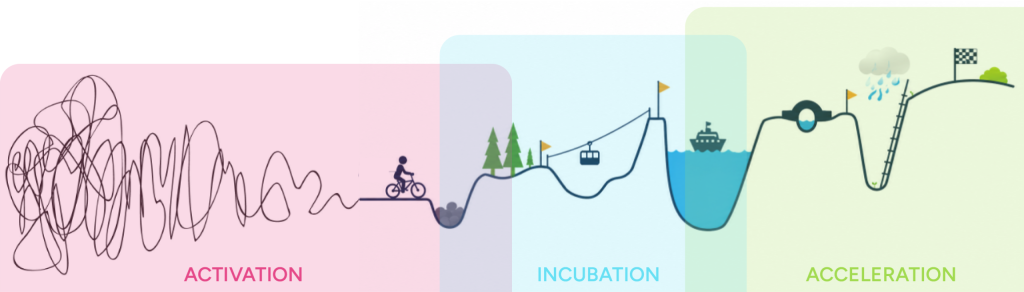
While there are clearly overlap and transition areas as entrepreneurs traverse their way back and forth between phases, each of these phases along the entrepreneurial journey is fundamentally different. They are not variations of the same work. They are different systems entirely that need to be optimized for different outcomes. Each phase requires different kinds of support. Different programming architecture. Different kinds of mentorship. Different skillsets of people doing the work.
We’re learning that the Activation phase is particularly unique.
Engaging entrepreneurs in this phase of the entrepreneurial journey requires a different approach—different language, different channels, different partners, different processes—that optimizes different outcomes and prioritizes attributes the entrepreneurs have in this messy part of the journey. For organizations focused on Incubation or Acceleration, working in this Activation phase can feel extraordinarily frustrating and inefficient.
Incubation and Acceleration often produce more visible outputs. Startups launched, funding raised, jobs created.
Activation produces things that can be harder to measure … but are impossible to ignore: movement from inaction to action.
Clarity and focus around their next steps
Increase in confidence and courage… which doesn’t just show up in their business but impacts every aspect of their lives and how they show up in their community.
And yet, many entrepreneurial ecosystems are designed to try and serve entrepreneurs at all three phases with only slight variations of the same tools, the same metrics, the same programs, and often with the same approach and with the same organizations leading the effort.
Not only does that create significant gaps in the design of our entrepreneurial ecosystems, but it also leaves untapped entrepreneurial potential ‘sitting on the sidelines’; people in our communities that are often overlooked and underestimated.
The Opportunity: Building More Complete Entrepreneurial Ecosystems
If we take entrepreneurship seriously as a tool for realizing the full potential of our communities, then we have to design systems that reflect the journey entrepreneurs actually take.
That means recognizing three things:
First, a large portion of our entrepreneurial potential exists outside formal systems.
Second, the earliest phase of entrepreneurship, the Activation phase, is a distinct and necessary part of the ecosystem that is often the most overlooked and least understood part of the entrepreneurial journey.
And third, that no single organization or single approach can effectively serve all phases of the journey equally well. Activation, Incubation, and Acceleration each require their own tools, approaches, and expertise.
Strong entrepreneurial ecosystems are not built on generalists trying to do everything. They are built on coordinated networks of organizations working in alignment, each focused on a different stage of the journey. That means designing with intention across all three phases, building strategic partnerships that leverage a wider variety of expertise in each phase of Activation, Incubation, and Acceleration, rather than expecting one group to do it all.
A Final Reflection
To realize the full entrepreneurial potential of our communities, the goal isn’t just to support entrepreneurs who are already visible in the ecosystem. We need more activated entrepreneurs engaging and circulating within the ecosystem. Because when someone moves out of that early-stage uncertainty and into action, a whole new world of possibility opens up to them. Programs make sense. Support systems become relevant. Networks become approachable.
They engage. They participate. They start building.
Activation isn’t a “nice to have” part of our entrepreneurial ecosystem. It’s a gateway for untapped entrepreneurs in our communities to get ‘off the sidelines and on to the field’, complementing and amplifying everything that follows. Upfront investments into efforts specifically designed for the Activation phase can have an outweighed impact on results that are possible in the Incubation and Acceleration phases.
If you are thinking about the design of your entrepreneurial ecosystem, the question is not just how well your system supports entrepreneurs who are already engaged.
The more important questions may be:
Who are we not seeing—and why?
And
What are we optimizing for?
The biggest opportunity for our entrepreneurial ecosystems is not always just supporting and scaling the potential we see. It is in activating the untapped potential that may be sitting on the sidelines … and reaching the entrepreneurs in our communities who may not be showing themselves to us just yet.
About Andrew
Andrew Button is founder of Mashup Lab. Andrew was invited to contribute this article as an international thought leader in the entrepreneurship-led economic development space. Click here to book a free, no obligation Discovery Call with Andrew to explore the untapped potential in your community and learn more about the work the Mashup Lab team has been doing in 700+ communities throughout the US and Canada.