

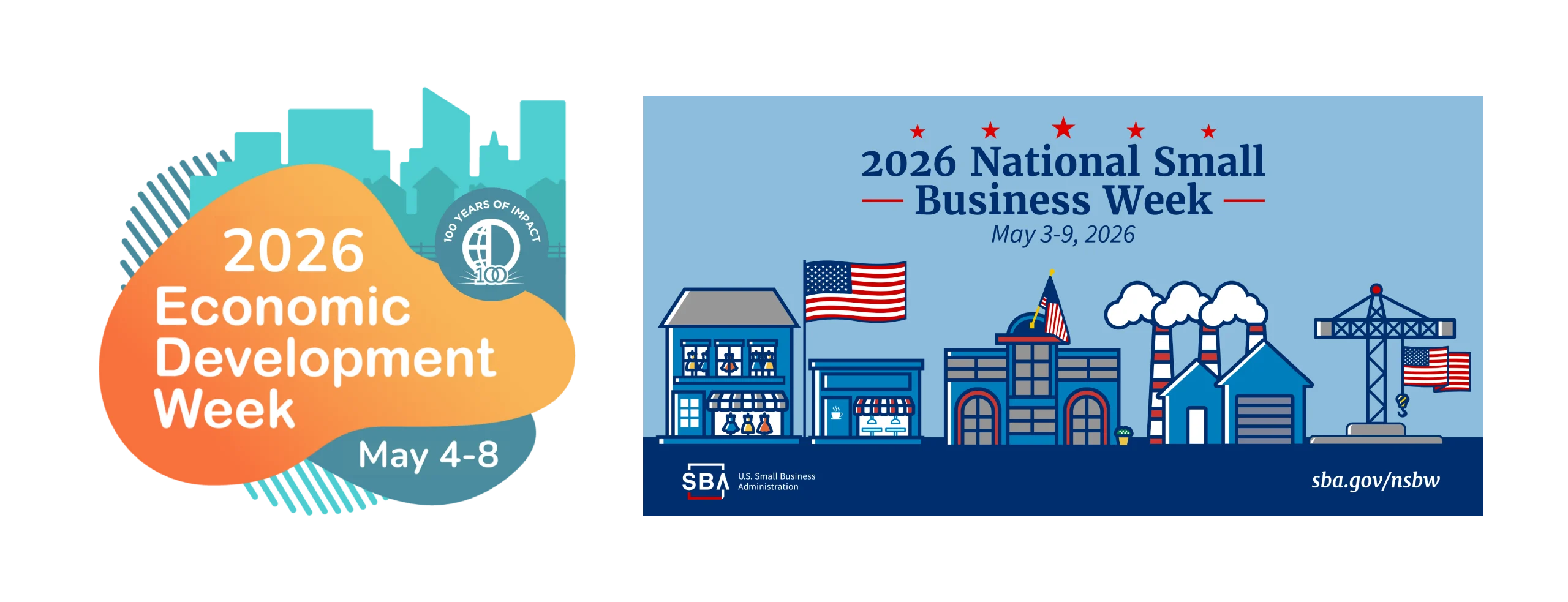
This year, The SBA's National Small Business Week and the International Economic Development Council's (IEDC) Economic Development Week land at the same time; the first week of May.
That overlap is more than a calendar coincidence. It’s a reminder of something economic developers and ecosystem builders see every day: you cannot separate entrepreneurs from the systems that support them.
For years, these two conversations have often run in parallel. One week celebrates entrepreneurs, their risk-taking, and their impact on our communities. The other highlights the work of economic developers who build the conditions for growth.
Both matter, but they matter most when they are connected.
Entrepreneurs drive growth, but systems make it possible
Small businesses are central to local economies. They create jobs, activate Main Streets, and shape the identity of a community. But entrepreneurs don’t succeed in isolation.
Behind every growing business is a network of support: advisors, capital providers, training programs, resource navigators, and community leaders working to make those connections possible. That is the work of economic development.
Economic developers are not just focused on outcomes like jobs and investment. They are connectors, conveners, and problem solvers working across systems to make sure entrepreneurs can access what they need, when they need it.
When those systems are fragmented, entrepreneurs feel it. When they are aligned, communities move forward faster.
Why this alignment matters right now
The past several years have made one thing clear: entrepreneurship is not a side strategy in economic development. It is central to how communities grow, adapt, and recover.
At the same time, the work of building and maintaining strong support systems has become more complex. Economic developers are navigating shifting funding environments, evolving community needs, and increasing expectations to show impact.
That is why this moment matters.
Celebrating entrepreneurs without strengthening the systems around them is incomplete. And investing in systems without listening to the realities of entrepreneurs misses the mark.
Communities that make progress are the ones that do both at the same time.
What this looks like in practice
So, what does it actually mean to connect these two efforts?
It starts with visibility.
Use this week to highlight not only the businesses in your community, but also the people and organizations working behind the scenes to support them. Tell the full story of how your ecosystem operates.
It continues with recognition.
Take time to acknowledge entrepreneurs and the economic development professionals who support them. Whether through awards, public recognition, or simple thank-yous, these moments reinforce the value of both roles.
It shows up in connection.
Create opportunities for entrepreneurs to engage with mentors, resource providers, and each other. Strong ecosystems are built through relationships, not just programs.
And it requires consistency.
The most effective communities do not treat this work as a one-week campaign. They build systems that provide ongoing access to resources, guidance, and support year-round.
The takeaway for community leaders
If there is one thing this overlap makes clear, it is this:
Entrepreneurship and economic development are not separate efforts. They are two sides of the same system.
When communities invest in both, and intentionally connect them, they create environments where businesses can start, grow, and stay.
That is how local economies become more resilient, more inclusive, and better positioned for long-term growth.
Keep the momentum going
As you recognize National Small Business Week and Economic Development Week, consider how your community is showing up for both.
Celebrate the entrepreneurs building your local economy. Support the practitioners strengthening your ecosystem. And look for ways to connect those efforts beyond this week.
Because the goal is not just to celebrate the work.
It is to make it stronger.